

We are so thrilled to celebrate Karen’s election into the National Academy of Engineering and to see her achievements recognized by such a prestigious organization. Karen has such a wealth of scientific knowledge, depth of understanding and breadth of interests that make her an expert researcher known around the world and a fantastic principal investigator. We are so thankful for the opportunity to learn from Karen and work to make her ideas reality in the lab. She has made a great impact on our scientific development, and we are so proud to acknowledge her impact on the whole scientific community.
Author: Aubry Hymel
-

A surprise from bottlebrush-polymer grafted nanoparticles
Previously, our group developed a novel technique for measuring diffusion coefficients
of bare nanoparticles in polymer melts using time-of-flight secondary ion mass
spectrometry (ToF-SIMS). We have investigated nanoparticles of various sizes, as well
as strongly or moderately attractive interactions with the polymer, and have mapped
how these characteristics impact nanoparticle diffusion. And we, naively, expected
nanoparticles with grafted bottlebrush polymers to behave similarly. Then, we did the
experiments and had quite a surprise.
Using ToF-SIMS, we measured the diffusion coefficients of polymer grafted
nanoparticles wherein the polymers are bottlebrushes with backbones of
poly(norbornene) and side chains of polystyrene grafted, and the nanoparticles are
large silica nanoparticles (80 nm radius). These nanoparticles were synthesized by Prof.
Rob Hickey’s Group at the Pennsylvania State University. When the bottlebrush
molecular weights are large relative to the matrix polymer, the nanoparticles display
core-shell diffusion behavior – this was our expectation. The surprise came when the
bottlebrush molecular weight is small relative to the matrix polymer, when the
nanoparticle diffusion is 10–100 times faster than predicted. We attribute this fast
diffusion to a local decrease in viscosity associated with the dewetting of the matrix near
the surface of these large nanoparticles. This is evidence of autophobic dewetting at the
surface of the nanoparticle.
And now there are more experiments to do and more questions. Could this happen with
a linear-polymer grafted nanoparticle? How large does a nanoparticle need to exhibit
this effect? Stay tuned!
Read the article in Macromolecules at https://doi.org/10.1021/acs.macromol.5c02957 -

Computational Postdoctoral Research Associate Opening
Amalie Frischknecht (Sandia National Laboratories) and I are seeking a postdoctoral researcher for a DOE-BES project entitled focusing on ion transport in nanostructured polymers. Candidates should have a PhD in chemical engineering, materials science, physics, chemistry, or another relevant discipline. They should also have a successful record in computational science, and a desire to develop innovative research advances. Good communication skills and the ability to work within a collaborative research team are essential. Prior experience with molecular dynamics simulations, ML/AI, and knowledge of polymer science are useful, although not required.
-

Dye Extraction from Polyester Fabrics — A Major Step Toward Recycling
While I was on sabbatical at NREL, I had the opportunity to learn more about NREL’s many efforts to reduce plastic waste. In this new paper in Nature Sustainability, Minjung Lee, Kat Knauer and the rest of the NREL team developed a method to extract dyes from polyester fabrics to make the fabrics easier to recycle. As an added bonus, the dyes can also be separated and reused. Eli Fastow and I provided structural characterization to further support their hypothesis that their dye extraction method does not perturb the crystalline structure. I’m looking forward to seeing how this method will be applied!
-
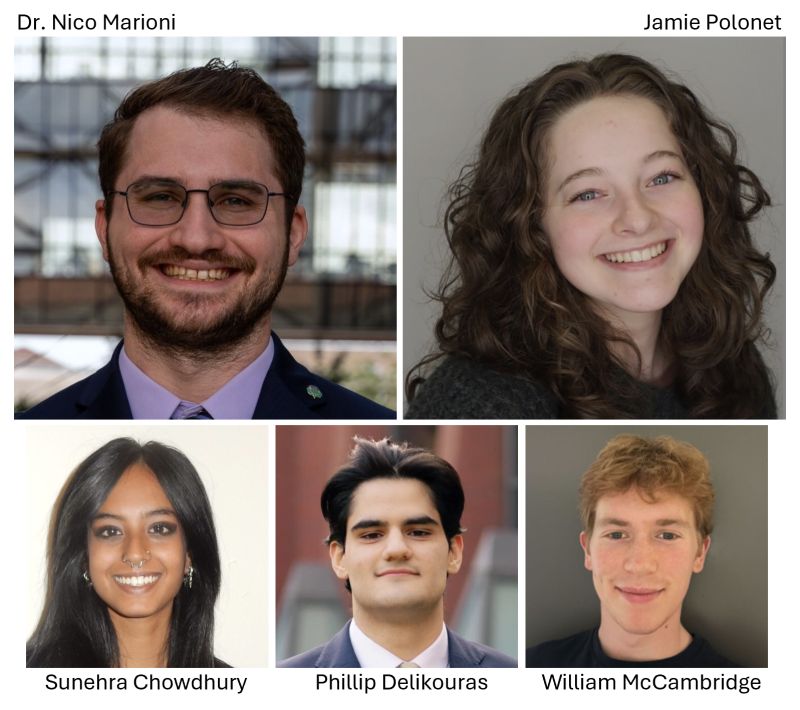
Welcome to the new Winey Group members!
I’m excited to welcome five new people to the group this semester. New people bring new ideas, new areas of expertise, and new energy that propels our research into new directions! I’m looking forward to seeing where we go together!
Dr. Nico Marioni completed his doctoral thesis at the University of Texas under the supervision of Prof. Venkat Ganesan and Prof. Benny Freeman. Nico has expertise in molecular dynamics simulations of charged and hydrated polymer systems and an exceptionally strong publication record. In collaboration with Dr. Amalie Frischknecht, he is joining our DOE-funded project to study proton-conducting polymer electrolytes.
A new master’s degree student (Jamie Polonet) and three senior undergraduate students (Sunehra Chowdhury, Phillip Delikouras, and Will McCambridge) are joining with Dr. Hoda Shokrollahzadeh Behbahani, a current postdoc in the group, to explore a new direction for polymer upcycling of polyolefins into higher value polymers.Please see our LinkedIn post here.
-
Our first paper about anion exchange membranes
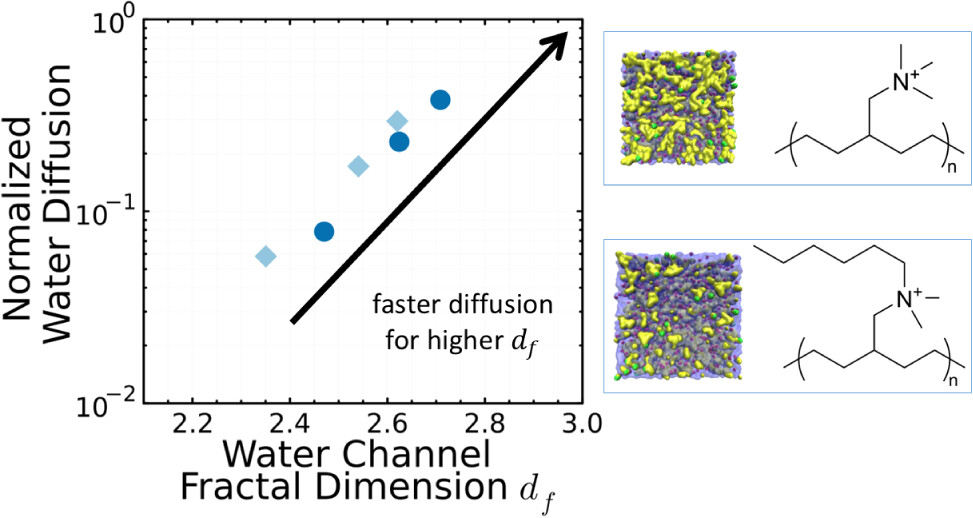
The scope of our DOE BES-funded team has expanded from proton-conducting polymer to include hydroxide-conducting polymers. I’m happy to announce our first paper in this area, entitled “Investigating Morphology and Diffusion in Simulations of Precise Anion-Conducting Polymers,” which recently appeared in Macromolecules. In collaboration with Dr. Amalie Frischknecht of the Center for Integrated Nanotechnologies at Sandia National Laboratories, we explored the structure and dynamics of two precise, hydrated polymers with quaternary ammonium groups using atomistic molecular dynamics simulations. Even at modest water contents, percolated nanoscale water channels form, and we quantify these non-periodic structures with channel width distributions, fractal dimensions, and characteristic length scales. Interestingly, we found a correlation between the fractal dimension and the diffusion coefficient of the hydroxide ion.
Our collaborator, Justin Kennemur of Florida State University, has recently synthesized these materials and we are busy characterizing their morphologies and conductivities. So, there is definitely more to come from us on anionic exchange membranes.
Also, here’s a special shout out to Emily Duan and James Johnson, two undergraduates at the University of Pennsylvania, who worked with Will Drayer on these simulations.
Read the article here: https://pubs.acs.org/doi/10.1021/acs.macromol.5c01789
-
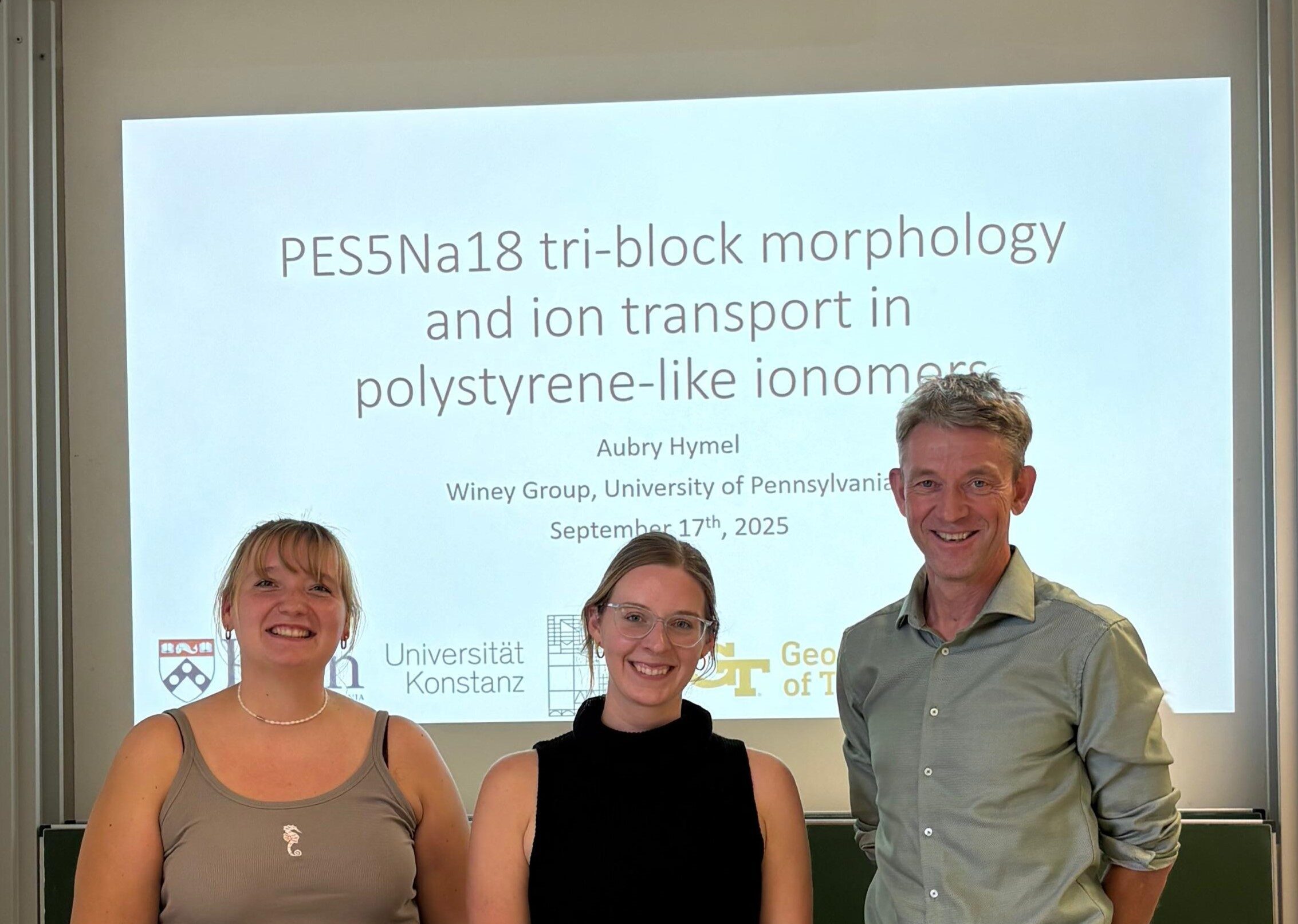
Aubry Hymel visits collaborators at the University of Konstanz
Last week, Aubry Hymel, a 3rd year PhD student in the Winey group, visited our collaborators Prof. Stefan Mecking and Viola Burlein at the University of Konstanz, Germany. Aubry is studying the self-assembly of precisely alternating multiblock copolymers synthesized by the Mecking group. During Aubry’s week-long stay at the University of Konstanz (September 15-19), Viola demonstrated the synthesis protocols, purification methods, and analytical techniques used to synthesize these remarkable polymers. Aubry even got hands-on experience making a polymer herself! She also gave a talk while in Konstanz entitled “PES5Na18 tri-block morphology and ion transport in polystyrene-like ionomers.” Many thanks to Stefan Mecking, Viola and the entire Mecking lab group for hosting Aubry last week and making her visit an enriching experience!